Choose Your Space for Play: Floating Docks, Water Hammocks, Dog Ramps and Gymnastics Equipment
A practical guide to choosing the right shape, size and setup for water days and guided practice.
By AWSUM Store Guide
Start with the day you want to have
A floating dock gives a group somewhere to gather above the water. A water hammock lets people lounge with the water around them. A dog ramp provides a route between the water and a boat, dock or pool edge. An air track belongs to a different decision entirely: choosing a surface for a planned gymnastics practice. Begin with that purpose before comparing colors, package names or photographs.
Think about a normal outing rather than the largest party you could imagine. How many people usually come? Does everyone want to swim, sit together, or move between a boat and the water? Will a dog join you? For training equipment, ask which activities your coach recommends at home. A clear answer helps you buy the equipment that serves the activity, then choose the right size within that category. Buying the biggest inflatable first can leave you with more equipment to carry and less of the feature you actually wanted.
Floating dock or mesh hammock?
A solid inflatable dock creates a continuous platform. Its useful qualities are the open deck, its dimensions and the way it fits your waterfront setup. A mesh hammock surrounds a recessed or suspended mesh area with an inflatable perimeter. Its center is intended for a different lounging experience from a solid deck. Check the photographs from above and from the side so you understand where people will sit and where water will reach them.
If your group wants one shared place to sit between swims, compare solid docks first. If the main attraction is resting in the water together, compare mesh hammocks. Neither label describes every model perfectly. Some products combine a deck and mesh opening, while others have removable mesh. Read the exact product description rather than assuming that a circular shape always means the same construction. Look at how much space remains around an opening and whether the model provides the seating arrangement you expect.
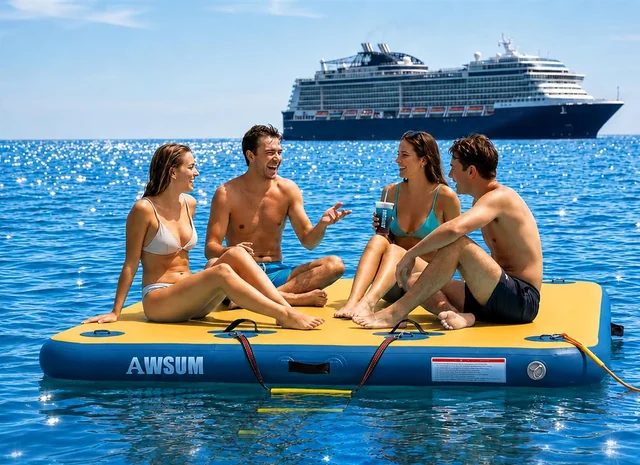
Read three dimensions, not one size name
A product described as a ten-foot dock may be square, rectangular or round. That single measurement cannot tell you how it fits beside a boat or how much usable space it offers. Write down the full inflated length, width and thickness. For a round product, check whether the stated size is the outside diameter or a model name. For a hammock, also look for the dimensions of the mesh center.
Compare the footprint with the place where you will inflate, launch and use the product. A useful paper sketch includes the boat or dock, the inflatable, the planned access point and any nearby equipment. This is a layout exercise, not a substitute for the manufacturer's installation instructions. It often reveals a practical problem early: the product fits on the water but has nowhere convenient to be prepared on shore. When dimensions are missing or contradictory, resolve that question before buying instead of estimating from a lifestyle photograph.
Separate load ratings from comfortable space
A stated weight capacity and a suggested number of users describe different things. A platform can have room for several people without their combined weight and equipment falling within its limit. Equally, a high load rating does not tell you whether everyone will enjoy the seating arrangement. Use the exact model's published limit and count the items that will actually be placed on it, as directed by its instructions.
Then consider space as a separate question. People sitting around the perimeter need a different arrangement from people reclining. A mesh center changes where bodies and feet can go. Photographs help explain the layout, but a photo of a busy gathering is not a capacity specification. Do not convert a people count into pounds or borrow a rating from a larger size in the same range. Keep the chosen variant's name and dimensions beside its capacity when comparing products so information from neighboring options does not get mixed together.
Plan the route back out of the water
For a floating platform, access deserves as much attention as deck space. Look at the actual entry features: handles, steps, a ladder, an attached ramp, or an approved separate accessory. Confirm what is included and what must be purchased separately. A picture that shows a complete waterfront arrangement may contain several products. Check the package list before assuming that every visible piece arrives together.
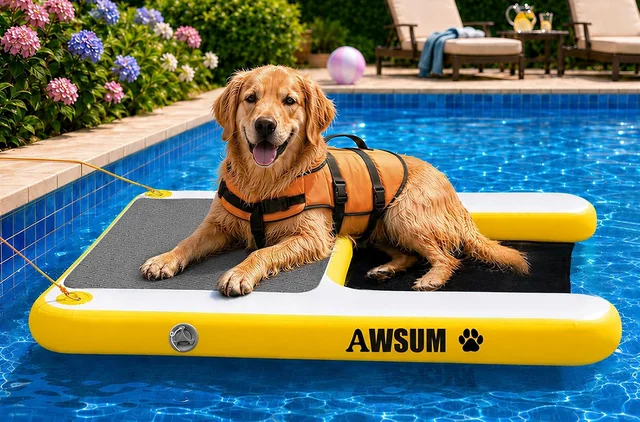
A dog water ramp answers a more specific access problem. The dog needs a suitable approach from the water and a workable transition at the upper end. Compare the ramp's entry shape, width, upper platform and intended attachment locations. A model intended to reach a low swim platform may not suit a taller dock. Product guidance about height and installation is more useful here than a general claim that the ramp works with boats. Measure your own setup and check it against the exact instructions before choosing.
Choose a dog ramp for both the dog and the landing
Start with the dog's weight and the model's stated limit, then look beyond that single number. Compare the width of the approach and the dimensions of the upper platform. Examine the traction surface and any underwater mesh or steps. The design should be understandable from the photographs: where does the dog first make contact, and where does it move after leaving the ramp?
Different dogs have different familiarity with water and unfamiliar surfaces. Plan time to introduce the equipment according to its instructions, with supervision, rather than expecting immediate independent use. If your dog has a mobility problem, ask its veterinarian about suitable activity and access equipment. A ramp's load rating does not establish suitability for a medical condition. Also think about who will stay nearby, where the dog can rest afterward, and how the ramp will be secured. These practical details matter more than matching the ramp's color to the boat.
Understand attachment before adding accessories
D-rings, handles and connection straps may look similar across products, but their purposes are not interchangeable. A carrying handle is not automatically an anchoring point. A connection loop does not establish compatibility with every other inflatable. Read the instructions for the approved connection points, included hardware and intended setup. If you plan to attach a ramp to a dock, verify both sides of that connection.
Look closely at package photography. Count the supplied straps or ropes against the written contents, and distinguish optional accessories from standard equipment. Avoid building your purchase around an assumed universal fit. When a manufacturer describes a modular range, check the specific products and connectors named in that range. A dock, hammock and ramp can all be useful on the same outing without being designed to fasten directly to one another. Choosing each item for its confirmed function gives you a clearer plan than treating every ring as part of an interchangeable system.
Make carrying and storage part of the comparison
The product's inflated footprint is only half of its size story. Check its weight, folded dimensions and the type of bag or carrying arrangement supplied. A bag with wheels serves a different route from a shoulder sling, especially when the walk includes sand, steps or an uneven shoreline. Consider who will handle the equipment and whether the packed item fits the vehicle or storage space you actually use.
Think through the return journey, too. You need somewhere suitable to inspect, clean and dry the product before longer storage, following its care directions. A large platform can be easy to enjoy on a lake and awkward to manage in a small apartment afterward. Choose a storage location before delivery. Keep the pump, compatible nozzle, instructions and small accessories together so the next outing does not begin with a search for a missing part. A manageable setup is more likely to become part of your routine.
Compare the complete pump setup
An included pump is useful only when you understand what it requires. Check whether it is manual or electric, which valve adapter is supplied, and whether you will have the required power source at the setup location. Confirm the pump's compatibility with the exact product. A pump designed for one kind of inflatable should not be assumed suitable for another simply because an adapter can be fitted.
Use the pressure instructions for the selected model and each applicable chamber. Do not copy a pressure number from a competitor, a different thickness or an accessory. Published inflation times are also difficult to compare when pump types and product sizes differ. A more useful buying question is whether the complete setup fits your outing: available power, suitable pump, gauge where required, accessible valve and a place to pack everything afterward. Follow the supplied instructions for inflation and deflation, and check the equipment before use rather than relying on yesterday's firmness.
Look at construction in useful detail
Material descriptions can become a list of impressive words without explaining the product. Compare details you can connect to a function: the deck covering, the construction of the inflated body, the valve, the edge seams and the attachment points. On a hammock, inspect how the mesh joins the surrounding ring and whether it is removable. On a dog ramp, examine the walking surface along the entire approach.
Close-up photographs are particularly useful when they correspond to the exact variant. They let you see handles, surface texture and fittings that can disappear in a wide lifestyle image. Treat terms such as heavy-duty or professional as broad descriptions until supported by specific construction information. A material name alone does not tell you the product's load limit, compatibility or appropriate use. Keep those questions separate. The aim is to understand how the product works and what its instructions require, not to award points for whichever listing contains the most technical vocabulary.
Keep the water plan separate from the shopping list
Choose equipment for the conditions and locations allowed by its manufacturer. A pool, a sheltered lake edge and open moving water are different settings, even when photographs make them look equally inviting. Check the place where you intend to use the product, the access arrangements and any applicable local rules. Follow the product's requirements for securing it and supervising users. Do not treat an inflatable recreation platform as a substitute for appropriate personal flotation equipment.
The U.S. Coast Guard encourages wearing an approved life jacket or buoyancy aid while on the water. Select appropriate equipment for the people and activities involved, and follow its fit and use instructions. Keep supervision and the return route part of the plan before unpacking. This does not require a complicated outing. It means deciding who is responsible for children and pets, where everyone enters and exits, and when conditions would make you pack up. Product features can support that plan but cannot replace it.
Treat gymnastics equipment as its own category
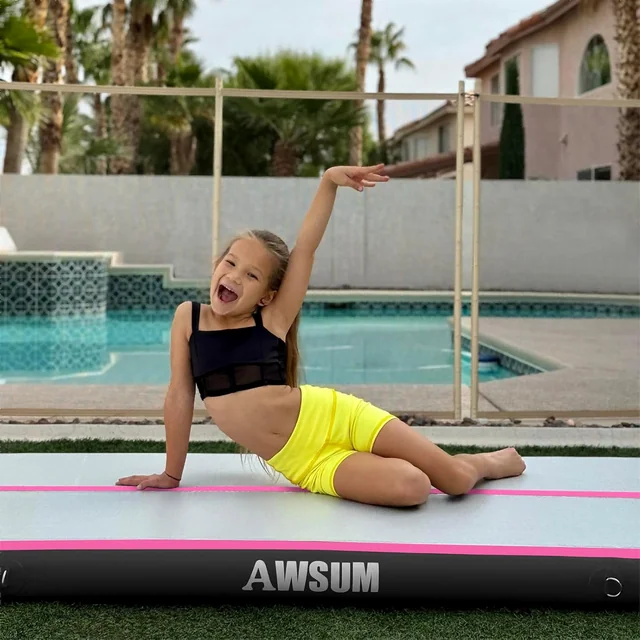
An air track, a training roller and a balance beam have different jobs. The track provides a rectangular practice surface. A roller is a shaped training aid whose suitability depends on the exercise and athlete. A beam provides a narrow balance surface. Start with the activity recommended by a qualified coach and then identify the equipment that supports it. Buying all three does not create a complete training program by itself.
Water equipment should not be substituted for a gymnastics surface because both products hold air. A floating dock's dimensions or load rating do not establish suitability for tumbling. Likewise, a gymnastics mat should not be treated as a general water platform without explicit instructions for that use. Keep comparisons inside the relevant category. For home practice, the most helpful shopping details are the intended exercises, equipment dimensions, placement requirements, handling and storage. This guide helps organize those decisions; it does not teach new skills or replace coaching.
Choose an air track around the practice space
Measure the room or outdoor area before comparing track lengths. Include furniture, walls, overhead obstructions, doorways and the route for bringing the equipment in. The rectangle that fits on the floor is not necessarily a suitable practice area. The activity, surrounding clear space, underlying surface and supervision must also be appropriate. Ask the coach what setup is suitable for the athlete's current work, then check the mat's instructions against that plan.
Width matters alongside length. It determines the available surface across the track, while thickness is another construction choice rather than a universal skill-level rating. Avoid assuming that the thickest option is automatically the right one or that a longer track makes an advanced activity suitable at home. Compare exact dimensions and placement guidance. If the product requires additional padding beneath or around it, include that in the space and budget. A smaller, suitable setup can be more useful than a larger item that cannot be used as intended.
Compare rollers and beams by their specific purpose
For a training roller, look for the dimensions, intended use and any guidance about the athlete or exercise. Its shape changes how it behaves compared with a flat mat. Choose it as part of a coached progression rather than from a photograph of someone performing a skill. Keep the supplied instructions available and confirm what other surfaces or equipment are required for the planned practice.
For a balance beam, compare the actual usable surface, overall length, height and base construction. Consider how it will be positioned and where it will be stored. A beam that folds has a different storage routine from a long rigid item. A low home-training beam is not interchangeable with every beam used in a gym. Match the purchase to the intended activity instead of relying on the word beginner as a complete specification. When comparing a track, roller and beam on one page, use separate descriptions so their different functions remain clear.
Check the package before comparing prices
Build a short list of what you need for your chosen setup, then compare it with each package. Depending on the product, that may include a pump, adapter, carrying bag, repair supplies, attachment hardware or instructions. Some items may be included, optional or unsuitable for that model. A photograph of accessories is helpful, but the written package list should establish what comes with the selected option.
Compare the complete purchase rather than the headline price alone. An inexpensive platform may require a separate compatible pump or carrying solution. A package with more accessories may include things you do not need. Read the return and warranty terms for the actual seller and product, including any restrictions on use or condition. Keep the model, size and color recorded together so a price comparison does not quietly switch to another variant. The best fit is the product whose specification and complete setup match your plans, within a budget you are comfortable with.
Build a routine that makes the next outing easier
Before first use, identify the valve, approved attachment points, pump adapter and care instructions. Check the unpacked product and supplied parts while you still have time to resolve a missing item or an unclear instruction. Keep the model information and purchase record somewhere accessible. This makes a later support question much easier to answer than a description based only on the product's color.
After use, follow the manufacturer's cleaning, drying, deflation and storage directions. Inspect the surface and fittings instead of putting equipment away without a look. Keep small components in a labeled pouch with the appropriate product, particularly if your household owns several inflatables with different valves or connectors. Revisit your setup after the first outing: was the bag manageable, was access convenient, and did the usable space match the plan? Those observations help you decide whether another accessory would solve a real need or simply add more equipment to carry.
Explore the collection
AWSUM Floating Docks
AWSUM Dog Water Ramps
AWSUM Air Tracks & Mat Sets
AWSUM Air Rollers
Further reading
- BOTE Hangout Dock specifications and included equipment
- Solstice Circular Mesh Dock product details
- Solstice Pup Plank model and access information
- DOK Inflatables Dog-DOK dimensions and comparison
- Tumbl Trak air tumbling track buying guide
- Tumbl Trak Air Floor specifications and use restrictions
- Solstice instruction manual library
- U.S. Coast Guard life jacket wear guidance